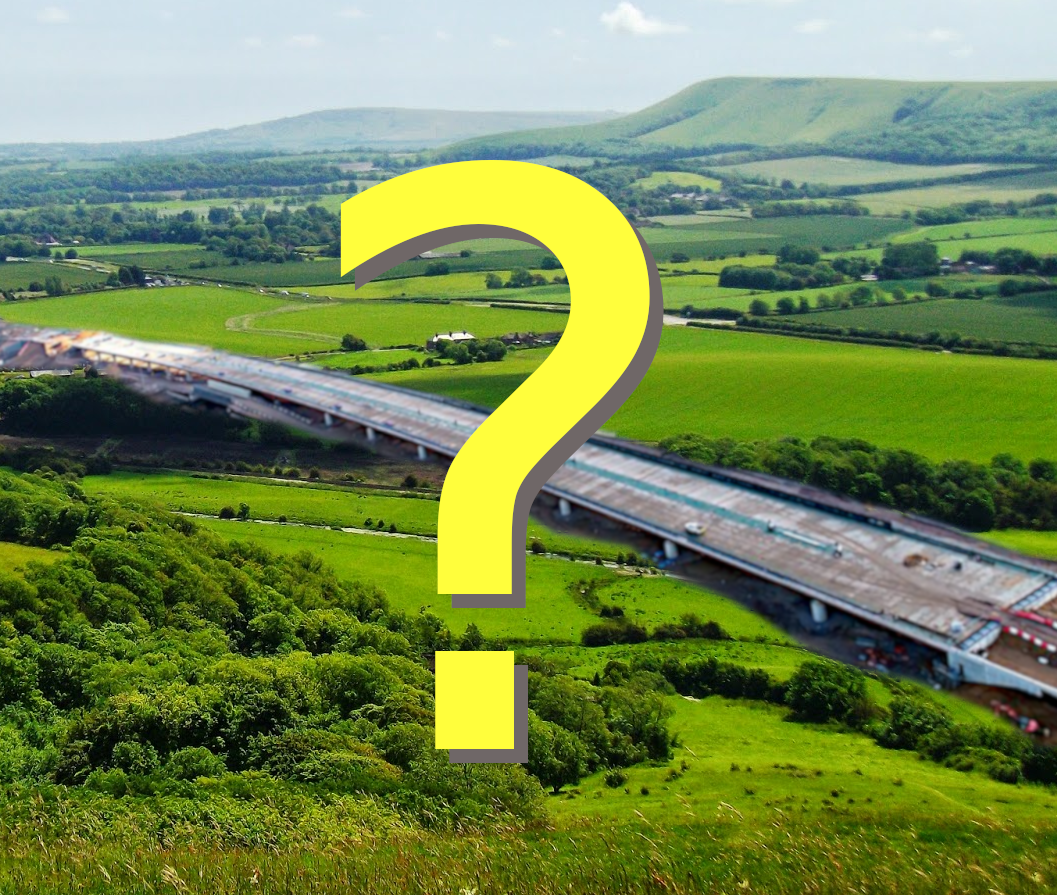
Any environmental risks associated with a new dual carriageway between Lewes and Polegate ?
Don't take my word for it. This is a list developed by Highways England's own consultants, WSP, dated April 2018.
- Much of the existing A27 East of Lewes lies within, or immediately adjacent to, the South Downs National Park (SDNP), so the views of the surrounding landscapes are therefore sensitive;
- Air Quality Management Areas (AQMAs) have been declared for Lewes Town Centre and Newhaven;
- There are a number of Sites of Special Scientific Interest (SSSIs) close to the existing A27, as well as Special Area of Conservation (SAC) sites at Lewes Downs and Polegate, a RAMSAR site at Polegate, a number of National and Local Nature Reserves, parcels of ancient woodland and the likely presence of European protected species;
- Flood Zones 2 and 3 are located within the study area, including near to Lewes and Polegate, and on the Cuckmere between Berwick and Wilmington; and
- 12 Noise Important Areas, including 4 at the A22/A2270 junction at Polegate;
- There are numerous Listed Buildings and Scheduled Ancient Monuments alongside or in close proximity to the existing A27; and
- Most of the area is good quality agricultural land but there are a number of disused landfill sites adjacent to the road near Lewes.
Environmental Risks 8.7.3.
The followings risks have been identified for the project from design through to construction:
- There is a risk that access will be denied to offsite areas for environmental surveying, resulting in delays to the project.
- There is a risk that the scheme will adversely affect the landscape within the South Downs National Park, resulting in objections from key stakeholders including the South Downs National Park authority.
- The scheme could result in adverse effects on the setting of; numerous Listed Buildings and Scheduled Ancient Monuments alongside or in close proximity to the existing A27.
- There is potential for adverse effects on sites which are designated for ecological conservation such as, SSSIs close to the existing A27, as well as SAC sites at Lewes Downs and Polegate, a RAMSAR site at Polegate, a number of National and Local Nature Reserves, parcels of ancient woodland and the likely presence of European protected species; resulting in objections from Natural England.
- There is potential for effects on, or loss of, BAP habitats, including Ancient Woodland, Deciduous Woodland, and Floodplain Grazing Marsh resulting in objections from a key stakeholder.
- There is a risk of unknown/unanticipated archaeological finds or sites, being found in the construction area, which may delay construction.
- The options located near to residential properties, increasing the risk of adverse effects as a result of increased noise levels and decreased air quality on sensitive receptors, which may result in objections from local residents. ¡
- There is a risk of unforeseen environmental constraints and local condition that have the potential to give rise to the need for additional studies e.g. the presence of protected species, invasive species, adverse ground water conditions or the presence of contamination. These unforeseen constraints may result in delays to the project and additional costs.
8.7.4. The Scheme is currently at the options identification stage and mitigation proposals have not yet been identified. Avoidance will be adopted where possible. Any mitigation measures proposed will aim to comply with HE objectives of achieving no net loss of biodiversity by 2020 and net biodiversity gain by 2040. Once the likely impact on environmental assets has been identified and options agreed for the route, suitable mitigation measures will be proposed.